When it comes to decluttering your wardrobe, the first step is often the hardest. It can feel overwhelming to face a closet full of clothes, especially if you’ve accumulated items over the years. A good starting point is to set aside some dedicated time for this task. Choose a day when you won’t be rushed, and gather some boxes or bags for sorting. The key is to approach your wardrobe with a clear mindset: you’re not just getting rid of clothes; you’re making space for what you truly love and wear.
Begin by taking everything out of your wardrobe. Yes, everything! Lay it all out so you can see what you have. This visual inventory can be quite revealing. As you sift through your clothes, ask yourself a few important questions: Have I worn this in the last year? Does it fit well? Do I love it? If the answer is no, it might be time to let it go. Be honest with yourself; holding onto items that no longer serve you only clutters your space and mind.
For those looking to enhance their home organisation, the article on wardrobe organisation tips for a clutter-free home is a fantastic resource. It provides practical advice on maximising space and maintaining order, which can be particularly beneficial when combined with insights from retail environments. To explore how professional shop fitouts can transform spaces, consider reading this related article on transforming your retail space with professional shop fitouts in Sydney. This can inspire you to create a more functional and aesthetically pleasing wardrobe at home.
Once you’ve decluttered, it’s time to organise what’s left. Maximising space in your wardrobe can make a significant difference in how you feel about your clothing collection. Start by categorising your clothes into groups: tops, bottoms, dresses, outerwear, etc. This not only makes it easier to find what you need but also helps you see if you have too many of one type of item.
Consider using matching hangers for a uniform look, which can make your wardrobe feel more organised. If space is tight, try hanging items vertically by using cascading hangers or tiered hangers that allow multiple garments to hang from one hook. For folded items, such as sweaters or jeans, stack them neatly on shelves or in drawers, ensuring that the most frequently worn items are easily accessible. This way, you won’t have to dig through piles every time you’re looking for something specific.
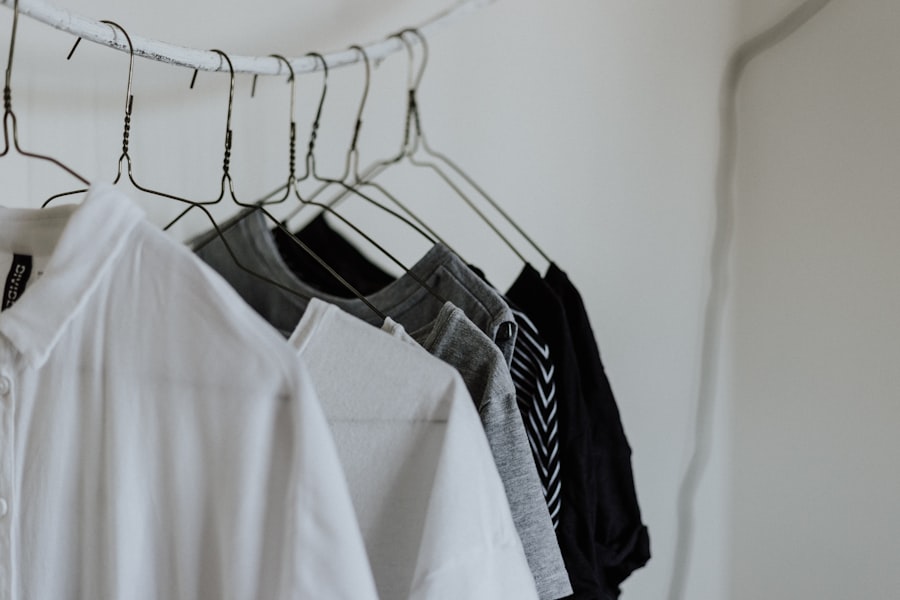
The KonMari Method, developed by Marie Kondo, has gained popularity for its unique approach to decluttering and organising. One of the key principles is to fold clothes in a way that allows them to stand upright in drawers or on shelves. This not only saves space but also makes it easier to see all your options at a glance.
To fold using the KonMari method, start by laying the item flat and folding the sides in towards the centre. Then, fold the bottom up towards the top, creating a small rectangle. Finally, stand the item upright in your drawer or on the shelf. This technique works particularly well for t-shirts, trousers, and even some dresses. By storing clothes vertically, you can avoid the dreaded ‘clothes avalanche’ that often occurs when rummaging through a stack of folded items.
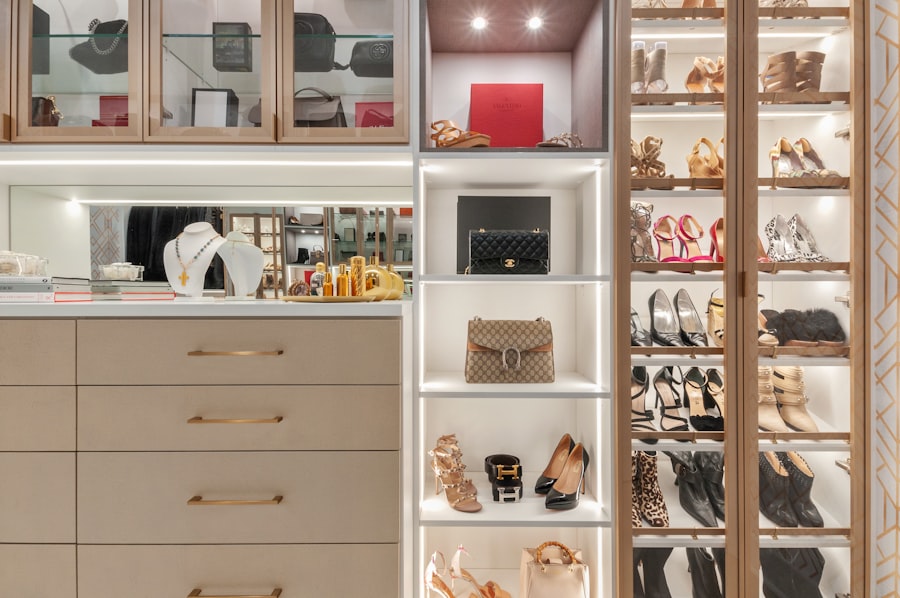
Shoes, bags, and accessories can often become the most chaotic part of a wardrobe. To keep these items organised, consider investing in storage solutions that suit your space and style. For shoes, clear plastic boxes are a great option as they allow you to see what you have at a glance while keeping them protected from dust. Alternatively, a shoe rack can help keep everything visible and accessible.
For bags, consider using hooks on the wall or inside your wardrobe door. This not only saves space but also displays your bags nicely. If you have smaller accessories like scarves or belts, try using drawer dividers or small bins to keep them tidy. You could also repurpose an old wine rack for storing rolled-up scarves or ties; it’s a creative way to keep everything organised while adding a touch of style to your space.
If you’re looking to enhance your home’s organisation, you might find it beneficial to explore related strategies for optimising your workspace as well. A well-organised office can significantly contribute to a clutter-free environment, allowing for greater productivity and peace of mind. For more insights on this topic, check out this informative article on how to transform your workspace with a leading office fit-out company aspecjoinery.
com.au/transform-your-workspace-with-a-leading-office-fit-out-company/’>here. Implementing these tips alongside your wardrobe organisation can create a harmonious living space.
Maintaining a seasonal wardrobe can help streamline your clothing collection and make getting dressed easier throughout the year. As seasons change, take the time to rotate your clothes accordingly. Store away items that are out of season—like heavy coats in summer or shorts in winter—so they don’t clutter your everyday wardrobe.
When storing off-season clothes, ensure they are clean and dry to prevent any unwanted odours or damage. Use breathable garment bags for delicate items and consider vacuum-sealed bags for bulkier pieces like winter coats or blankets. Labeling boxes or bags can also save time when it comes to retrieving items later on. This seasonal rotation not only keeps your wardrobe organised but also gives you a chance to rediscover pieces you may have forgotten about.
If you’re looking to enhance your wardrobe organisation skills, you might find it beneficial to explore the differences between built-in and freestanding wardrobes. An insightful article on this topic can be found here, where you can discover which option might best suit your needs and help you achieve a clutter-free home. Understanding the advantages of each type can significantly influence how you organise your space and maximise storage efficiency.
A capsule wardrobe is all about simplicity and versatility. The idea is to curate a collection of essential pieces that can be mixed and matched easily, reducing decision fatigue when getting dressed. To create your own capsule wardrobe, start by identifying your personal style and the types of clothing that make you feel confident and comfortable.
Aim for a limited number of items—typically around 30-40 pieces—excluding accessories and shoes. Focus on quality over quantity; choose timeless pieces that won’t go out of style quickly. Neutral colours often work best as they can be paired with various other items in your collection. By having fewer clothes that you truly love and wear regularly, you’ll find that getting dressed becomes a more enjoyable experience.
Jewellery and accessories can easily become tangled or lost if not stored properly. To keep these small items organised, consider using trays or small boxes with compartments specifically designed for jewellery storage. This way, necklaces won’t get tangled with bracelets, and earrings will stay paired together.
For those who prefer a more visual approach, hanging organisers can be an excellent solution. A wall-mounted jewellery organiser allows you to display your pieces while keeping them easily accessible. You could also use decorative bowls or dishes on your dresser for everyday items like rings or watches; this adds a touch of style while keeping things tidy.
Once you’ve put in the effort to declutter and organise your wardrobe, it’s essential to maintain that order over time. Regular maintenance is key to ensuring that your wardrobe remains functional and enjoyable to use. Set aside time every few months to reassess your clothing collection; this could be as simple as checking for items that no longer fit or styles that no longer resonate with you.
Additionally, make it a habit to put things back in their designated spots after wearing them. This small action can prevent clutter from building up again. If you find yourself bringing new items into your wardrobe—whether through shopping or gifts—consider adopting the ‘one in, one out’ rule: for every new piece you add, let go of an old one. This practice helps keep your collection manageable and ensures that every item has its place.
By following these steps and tips, you’ll not only create an organised wardrobe but also cultivate a space that reflects your personal style and makes getting dressed each day a pleasure rather than a chore.
Proper wardrobe organization helps in maximizing space, reducing clutter, and making it easier to find and access clothing and accessories.
Some effective wardrobe organization tips include decluttering regularly, using storage solutions such as shelves and drawers, categorizing clothing items, and utilizing space-saving hangers and dividers.
To declutter your wardrobe effectively, start by sorting through your clothing items and getting rid of anything you no longer wear or need. Consider donating or selling items that are in good condition and disposing of items that are worn out or damaged.
Space-saving storage solutions for a clutter-free wardrobe include using hanging organizers, stackable bins, under-bed storage containers, and shoe racks. These solutions help maximize space and keep items organized.
It is recommended to organize your wardrobe at least twice a year, typically at the beginning of each season, to declutter and reorganize clothing items. Regular maintenance and decluttering will help maintain a clutter-free home.
Don’t Take Our Word For It
Aspec has recieved fantastic 5/5 Star Rating from its clients!
Professional from start to finish!
Wow! Omar was fantastic right from the very beginning! With 6 weeks to go until baby number 2s arrival, Omar delivered on his word to create a phenomenal outdoor kitchen for our alfresco area! It is exactly the vision we had in mind! We are so impressed with the workmanship and quality as well as the effort to get the work completed in such a tight timeframe. Very open and honest about pricing upfront also! Would highly recommend Omar and his team. The level of professionalism, honesty, workmanship and quality was spot on and always has time to discuss and go through any questions or concerns. Thank you A Spec Joinery for doing a fantastic job and in the short time we had to do it by! Particularly fitting us in a busy December!
Bianca M Vucetic
Professional from start to finish!
Great attentions to detail very informative throughout highly reccomend!
Mark, Double Bay
Professional from start to finish!
Omar installed a new kitchen for us. The process was easy and Omar kept in contact with us at all stages. The kitchen was installed in only a couple of days and looks fantastic. We’re very happy with the result.
Mat Pal
Professional from start to finish!
Omar was excellent to deal with. He and his team built and installed a large built-in wardrobe and cupboard, giving us good advice on the design. He was very professional in surveying the complex space for the units – it’s an older house with uneven floor and ceiling – and in preparing the design. His team constructed the units off-site within the time he indicated. Installation was complex and went very smoothly. The whole project was on time and on budget and the product delivered was of the highest quality. We would certainly use him again and recommend him to our friends.
Phillip Hart
Professional from start to finish!
Omar was fantastic to deal with and produced outstanding quality work for our new storage cupbaords and floating shelves. The final product was exactly what we wanted and made with care and attention. We highly recommend him for joinery and cabinetry works. Many thanks, Vince
Vincent Banton
Professional from start to finish!
Omar and his team are awesome. Professional, efficient and really went the extra mile creating beautiful joinery for my studio. Will definitely engage their services again and refer to anyone.
Carla Sconce
Professional from start to finish!
Dealt with Omar from A Spec on our office fit out, all work was done ahead of time and costs were maintained the whole way through. Would happily use A Spec again or recommend to anyone without hesitation.
Emanuel Karantonis
Professional from start to finish!
My experience with Omar and his team has been amazing and trouble-free.
Omar’s attention to detail and quick response time gave me comfort and confidence that the end product would be great.
Being in the construction industry, I couldn’t fault their workmanship and timing. Everything delivered on time and on budget.
Would definitely use Aspec Joinery again.
Ben Yee
Professional from start to finish!
Omar and the team at A Spec Joinery built our kitchen and bookshelves in 2021. The work is really high quality. It’s now 2024 and everything still looks great and functions just like the day they were built. I would highly recommend A Spec, particularly for the after build service. Nothing is too much trouble for Omar.
Alistair McLean
Professional from start to finish!
Omar and his team have worked wonders on all our joinery for our renovation, they constantly went above and beyond during all aspects of the build from planning to manufacturing and installation.
They have done an absolutely beautiful job and it is my pleasure to recommend A-Spec joinery to everyone.
Their professional attitude was exemplary and it was always lovely having Omar and the team in our house, they made an extremely stressful renovation into a positive experience.
A-Spec Joinery made our dreams come true and there are no words that can express how appreciative we are and so happy that we chose them.
If you want the best go with A-Spec Joinery.
Vincent & Anna
Vincent Jones
Professional from start to finish!
Paul Casey
Professional from start to finish!
Matt B
Professional from start to finish!
Our experience with A Spec Joinery was outstanding. We were happy with every phase of our project from initial concept to drawings to finished products. Omar and his team’s attention to detail was fantastic. Highly recommend!!!
Sharon Antonir
Professional from start to finish!
High quality work, on time on budget very professional would engage their services again 100%. 2yrs on asked Omar for additional work and once again very professional, on time and very helpful.
Maurice Natoli